
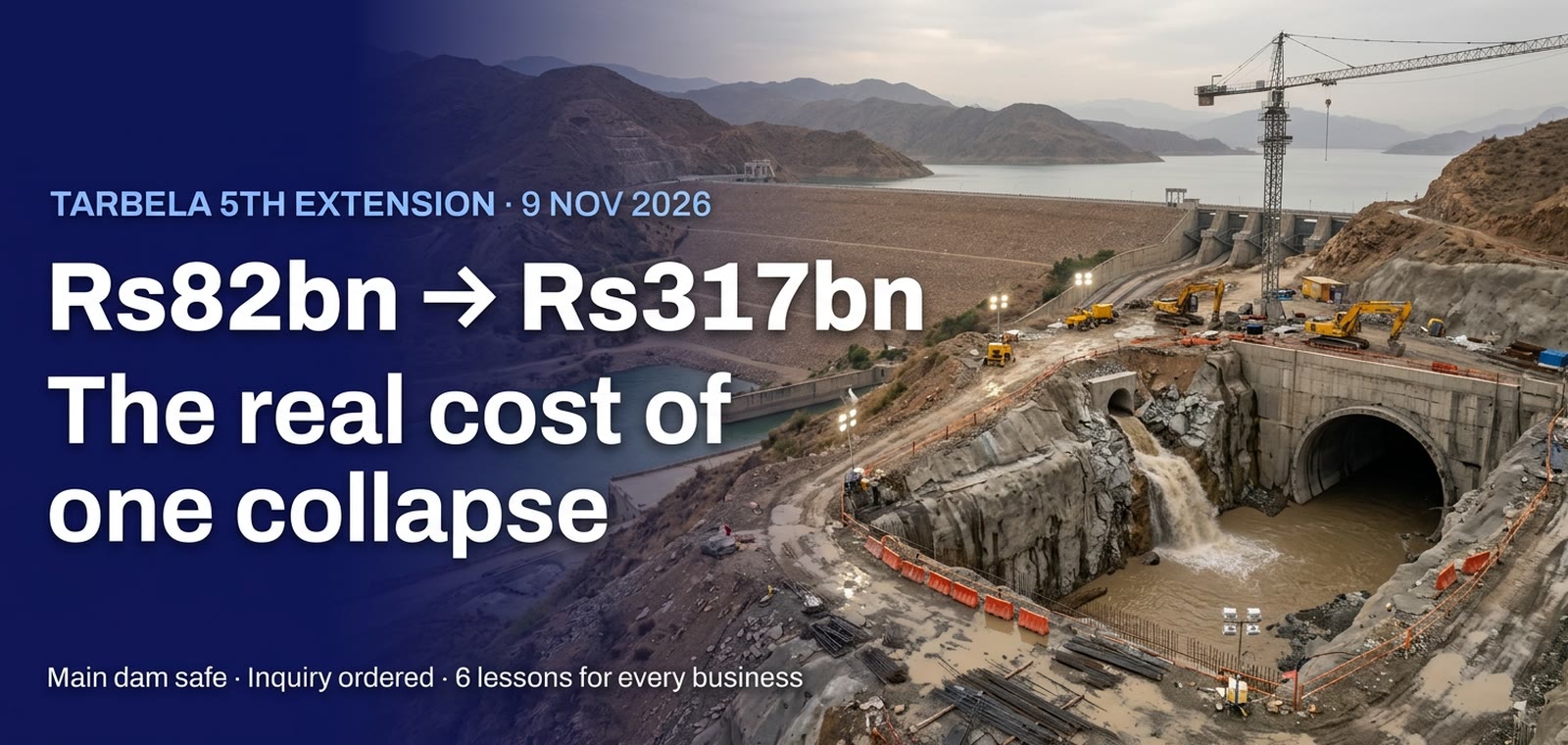
On Monday 9 November 2026, part of the rock collapsed at the Tarbela 5th Extension (T5) hydropower project in Khyber Pakhtunkhwa, and water flowed into the construction works. Videos spread quickly on social media, and many people asked the same question: is Tarbela Dam safe?
According to WAPDA, yes. The main dam is not at risk. But the incident is the latest setback for a project whose cost has already gone up almost four times, and it carries lessons for every business that runs a big project, from a new factory to an ERP system.
What happened
According to WAPDA's statement, reported by Business Recorder and other outlets:
- A weak section of rock collapsed while workers were excavating the second level ("bench") of the connecting tunnel.
- Water from the intake pit flowed into the tunnel and the under-construction powerhouse area.
- No injuries or deaths were reported.
- WAPDA said the main tunnel, powerhouse, tailrace culvert and switchyard were not damaged, and that there is no threat to the main Tarbela Dam or its structures. The consultants, the contractor and WAPDA's own teams agreed on this.
- Work was suspended, and WAPDA's Chairman ordered a departmental inquiry. According to reports citing sources, it will include experts from outside WAPDA and is expected to report within about a week.
What caused the collapse is not yet known. The inquiry will decide whether it was a natural weakness in the rock, a design issue or a construction issue.
Why T5 matters
Tarbela is Pakistan's largest dam. The fifth extension adds a new power plant to an existing tunnel:
- New capacity: 1,530 MW (three units of 510 MW)
- Tarbela's total capacity after T5: from 4,888 MW to 6,418 MW
- Expected electricity: about 1.35 billion units a year
- Main contractor: Power Construction Corporation of China (PowerChina)
- Financing: World Bank ($390m in 2016, plus $300m more in June 2026) and AIIB ($300m)
This is cheap, clean, local electricity, which matters for a country that pays heavily for imported fuel.
The cost problem: from Rs82bn to Rs317bn
The bigger story is not this week's collapse. It is what had already happened before it.
- Approved cost in 2017: about Rs82.4bn
- Revised cost (reported July 2026): about Rs317bn, an increase of around 285%
- Completion: originally 2026. Reports now point to around 2028 (sources give dates between mid-2027 and mid-2028)
- The World Bank's extra $300m in June 2026 was approved to cover higher inflation, extra civil works, repairs to the Tunnel 5 gates, and interest during construction
The Planning Commission has said the project's electricity could cost around Rs27–28 per unit over its life, which could make it the country's most expensive renewable project. A large part of that comes from delay and borrowing costs, not from the power plant itself.
The earlier collapse: what the inquiry found
This is not the first incident. In August 2025, a cofferdam (a temporary wall that keeps water out of the work site) collapsed and flooded the site. According to Profit and ProPakistani, citing Dawn, a government-appointed inquiry found:
- The contractor proposed a rock-filled cofferdam that the contract did not allow.
- The consultant conditionally accepted it, and WAPDA approved it when construction was nearly finished.
- Water flows were within Tarbela's normal historical range. The failure was blamed on inadequate protection layers and filters, not on unusual floods.
- All three parties, the contractor, the consultant and WAPDA, were held responsible.
That finding is about the 2025 collapse only. The cause of the 9 November 2026 incident has not been decided.
6 project-risk lessons for businesses
You may never build a dam, but every business runs projects: a new branch, a factory line, a warehouse, a software system. The same mistakes cost money at any size.
1. Approve changes before work starts, not after.
In the 2025 case, a design change was approved when the work was almost done. In your business, every change to scope, design or supplier should be approved in writing before money is spent. Late approval means nobody really controlled the decision.
2. Delay is a cost. Put a number on it.
A large part of T5's overrun is inflation and interest during construction. For your project, calculate what one month of delay costs you in rent, salaries, interest and lost sales. That number tells you how much it is worth spending to stay on schedule.
3. Keep a contingency, and protect it.
Big projects almost never finish on budget. Set aside a contingency reserve (often 10–20% for building work), and let only one senior person release it.
4. Make the supervisor independent and present.
The 2025 inquiry also pointed to weak oversight. Whoever checks the contractor's work, whether an engineer, a consultant or an internal auditor, must be independent of the contractor and actually on site.
5. Check your contracts for who pays when things go wrong.
Before you sign, know who bears the cost of damage, delay and redesign, what insurance covers it (contractor's all-risk, business interruption), and how claims are made. Many businesses discover these answers only after an accident.
6. Report bad news early.
Cost overruns grow when problems are hidden. A simple monthly project report, covering budget vs actual, % complete, risks and decisions needed, lets owners act while problems are still small.
FAQ
Did Tarbela Dam collapse?
No. According to WAPDA, a weak section of rock collapsed in the connecting tunnel works of the T5 extension project, and water entered the work area. WAPDA says there is no threat to the main dam.
Was anyone hurt?
WAPDA and most outlets reported no injuries or deaths.
What caused the collapse?
It is not yet known. WAPDA has ordered a departmental inquiry, which reports say will include outside experts.
How much does the Tarbela 5th Extension cost now?
About Rs317bn, according to reports in July 2026, up from about Rs82bn approved in 2017.
Will this affect electricity prices?
Not directly or immediately. But delays and higher project costs feed into the cost of electricity over time. The Planning Commission estimates the project's power could cost around Rs27–28 per unit over its life.
Need help?
HLM Consultants helps businesses plan and control the money side of big projects: budgets, contingency, cash-flow forecasts and monthly project reporting. See our Financial Modelling and Cash Flow Forecasting services, our Compliance and Risk Advisory, or contact us.
Sources: Business Recorder, Pakistan Observer and International Water Power (9 November 2026); The News and Nukta (10 November 2026); Profit by Pakistan Today (11 June and 13 July 2026); ProPakistani (13 July 2026). The cause of the 9 November 2026 incident is under inquiry; findings quoted relate to the August 2025 cofferdam collapse. Figures as reported. This post is general information, not engineering or investment advice.